



Beech (Fagus sylvatica) is a common tree in the UK, forming towering natural cathedrals that are often carpeted with bluebells in spring. Whether planted as hedgerows or left to mature into grand old trees, their smooth grey trunks—resembling elephant’s legs—make them easy to identify.
As we move into spring, we enter the prime time for gathering beech leaves in the UK, but the window for picking them is short. When young, the leaves are soft, tender, and perfect for eating, but they quickly toughen as they fill with cellulose and lignin—the same compounds that make beech leaf litter slow to decompose.
Fresh beech leaves are easy to recognise in spring and once we introduce them at the beginning of our spring foraging and wild food courses in North Wales, we notice ongoing grazing of beech leaves throughout the rest of the course. They emerge a vibrant lime green, with a delicate, almost translucent quality. Their edges are gently wavy, and they are covered in fine, silky hairs that give them a soft texture. As they mature, the hairs disappear, the green deepens, and the leaves become more rigid. This rapid transformation means that the ideal time to forage them is limited—typically from mid-April to late May in the UK, depending on local conditions.
When foraging, always harvest responsibly. Pick only the youngest, freshest leaves and avoid taking too many from any single tree. Be mindful of local wildlife and ensure that the trees you’re gathering from are not in polluted areas, such as near busy roads.
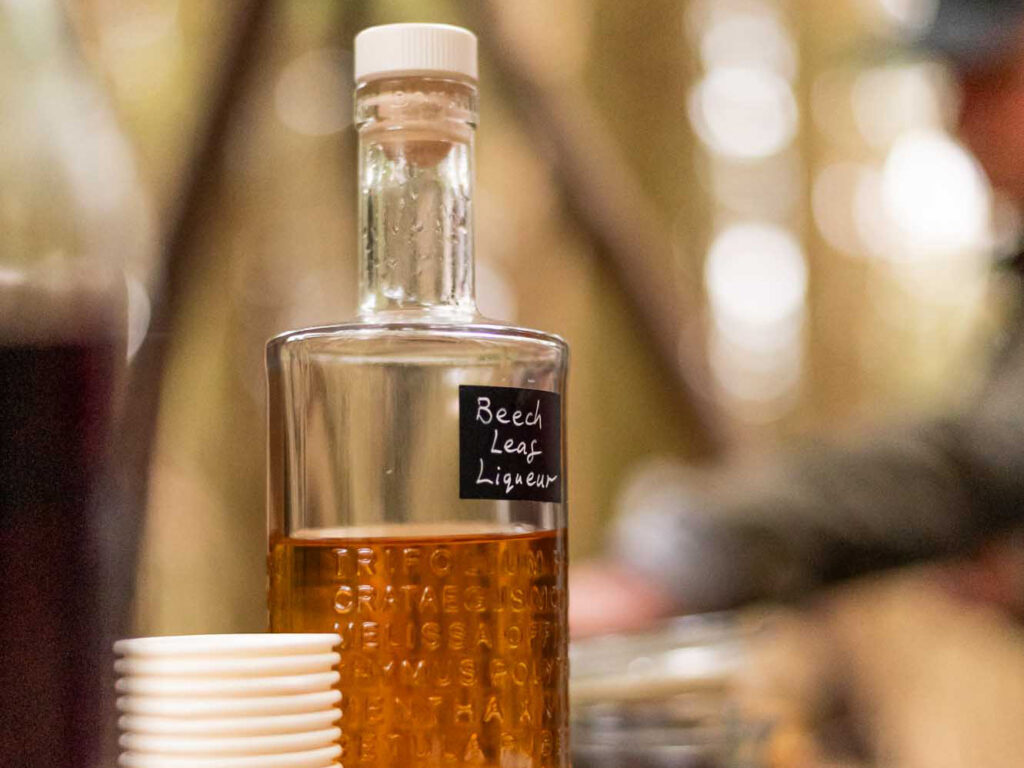
Young beech leaves have a mild, slightly citrusy taste with a hint of astringency. They make an excellent addition to spring salads, bringing a subtle freshness to the plate. Another traditional use is in beech leaf liqueur, a lesser-known but delicious foraged drink. To make it, fresh beech leaves are steeped in gin (or another neutral spirit) for several weeks before straining out the leaves and mixing the liquid with a small amount of Brandy and a simple sugar syrup, resulting in a smooth, herbaceous liqueur that captures the essence of spring.
Beech trees are highly competitive. Their tall, spreading crowns create dense shade, making it difficult for other plants to thrive beneath them. In beech plantations, however, early spring flowers like bluebells and wood anemones take advantage of the brief period of light before the canopy fully develops.
The thick beech canopy also means heavy leaf fall in autumn. These leaves, rich in lignin, decompose very slowly and form a dense, papery layer that further suppresses undergrowth. This slow breakdown of organic material is why beech woodlands often have sparse ground flora—but they are rich in fungi that can break down the lignin into useful nutrients. Many woodland mushrooms, including edible species, thrive in these environments as fungi are among the few organisms that can break down lignin effectively. Some of our most successful Chanterelle (Cantherelles cibarius) and Porcini (Boletus edulis) patches are in beech woodland.
Beech leaves are relatively easy to identify, but they can sometimes be confused with lime (Tilia sp) when young. Lime leaves also emerge bright green in spring and have a soft texture, but they are more heart-shaped, whereas beech leaves are more ovate with wavy edges. Additionally, lime leaves lack the fine silky hairs that cover young beech leaves. Taking note of these subtle differences will help ensure correct identification when foraging.
Every year Wild Food People run a calendar of foraging and wild food courses in North Wales.
From forests and meadows to seashore and coastal – all of our courses are focused on food, ecology and giving participants the confidence to go and find these foods for themselves.


We deliver expert foraging and wild food training as part of our wider work managing habitats in North Wales.
Every single one of our courses and events feeds back into improving those habitats, helping to provide healthy ecosystems for our local wildlife and communities.
To provide the best experiences, we use technologies like cookies to store and/or access device information. Full information can be found in our Privacy Policy